
Wheelchair and Priority Seating Enforcement!
A new state law and MTS policy require passengers to relinquish their seat to seniors and people with disabilities if the seat is located in a wheelchair or priority seating area of the bus or Trolley or you risk a fine.
We are dedicated to providing accessible and convenient transportation solutions for San Diego residents and visitors. All buses and Trolleys have accessible systems designed for ease of use for all passengers.
Limited Mobility Info
Buses and Trolleys have ramps or lifts to provide access for riders using wheelchairs, scooters, crutches, walkers or other mobility aids. Bus operators will assist riders in wheelchairs and scooters. On buses, wheelchairs and scooters are required to be 100% secured using fastening straps located in the wheelchair area.
Tips for Wheelchairs and Scooters
- Watch out for trash cans and other large objects when you’re positioning yourself to wait. These obstacles can prevent the ramp from working properly.
- Avoid positioning yourself on inclines or uneven surfaces where possible.
- Make sure you only carry as many bags and packages as you can safely keep on your lap or under your seat.
- Lock your brakes while the bus, trolley or lift is in motion.
- Take advantage of priority seating options so you can get on and off as easily as possible.
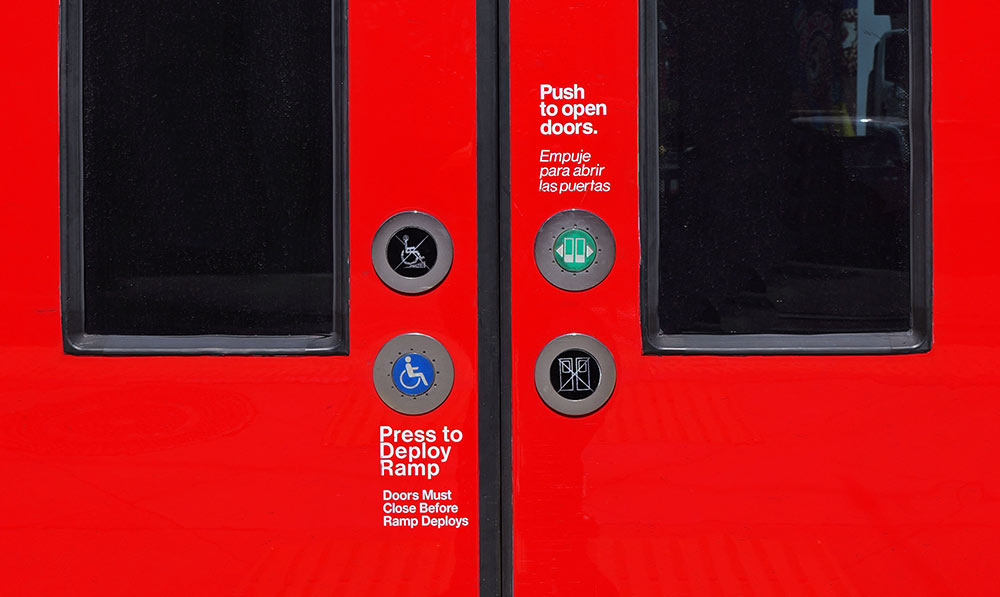
- Press the blue ADA button on Trolley doors to use the ramp for boarding and exiting. On board the Trolley, press button (or ADA seat pull) before arriving at your stop. On buses, please ask the operator to deploy ramp.
Visually Impaired Rider Info
Transit Centers, transit stations, Trolley stations, buses and Trolleys use auditory cues or signs with braille and raised letters to help our visually impaired riders navigate public transportation safely and easily.
Traveling by Bus
Boarding:
- All transit centers and stations have bus stop poles with signs with raised letter and braille plates identifying route and direction (N.S.E.W.)
- Operators announce their route number when they open the doors at a stop serviced by multiple routes
Inside the bus:
- Operators or an automated system announce major stops on all routes
- Announcements are also made for:
- Passenger requested stops
- Transfer points
- Signaled intersections with bus stops
- Scheduled time points along routes
- The first stop following a turn on the route
- Courtesy seating at the front of the bus is available on a first-come first-served basis
- Stop cord located under disabled seating
- PRONTO Cards should be tapped on the fare box next to the bus operator when boarding the vehicle; the operator can help you locate the tapping target
Traveling by Trolley
Boarding:
- The edge of the boarding platform is textured
- Tactile mats with directional bars are at all Trolley stations and line up with the Trolley doors
- The line and destination of the train is announced inside the Trolley and outside on the platform upon arrival
- A raised letter and braille sign is mounted on a poll on each side of the platform, providing the station name and destination of each train serving that station
- PRONTO Card tap towers are generally located at both ends of the station platform, however at some stations they are mid-platform
Inside the Trolley:
- The line and destination of the train is announced inside the Trolley
- The station name is announced inside the Trolley just before arrival at many stations
- If you stand on the tactile mat, the driver will verbally announce the train line and final destination at stations without automated announcements
- Courtesy seating near the doors is available on a first-come, first-served basis
- Intercom button is available for assistance
Tips
- Listen for the announcement of the next station or stop so you can prepare to exit the vehicle safely
- On the bus, sit near the driver to be sure you hear your stop announcement
- Braille flip books are available for purchase at The Transit Store in downtown San Diego to assist in flagging the correct bus route or Trolley line
- Alternative Formats for people with disabilities or Limited English Proficiency:
- MTS information will be made available in an alternative format by calling 619.231.1466
Hearing Impaired Rider Info
Bus stops, Trolley stations and transit stations are all equipped with easy-to-read signage and we have two TTY/TDD numbers available to riders to contact our Regional Transit Information Office.
Southern San Diego County: 619.234.5005
Northern San Diego County: 888.722.4889
At Bus Stops, Transit Stations and Transit Centers
- Each stop is clearly marked with the route or routes that serve that location
- Digital signs on the front and side of each bus display the route number and destination
- At Transit Centers and most Rapid Stations, overhead digital signs display departure times for each route serving that location
- At Transit Centers and Rapid Stations additional signs and maps may be posted to provide information about routes serving that location and the surrounding area
On the Bus
- The Stop Requested sign near the front of the bus lights up when the next stop has been requested by pulling the yellow cord
- Most buses have an overhead electronic message sign that displays the name of the next bus stop, major street, Transit Station or Transit Center
- Transit Stations and Transit Centers have electronic signs that display departure times for routes serving that location
At Trolley Stations and Transit Centers
- Digital displays on the front and side of each Trolley show the line name and final station destination
- System Maps, How to Ride Instructions, Explore Maps of the station’s surrounding area and timetable signs are available to provide additional information
- Ticket vending machines display text prompts for purchasing a ticket.
- Digital displays display departure times for next Trolley at many stations and printed schedules are displayed at each stop
On the Trolley
- System maps show the three Trolley lines and each station on each line; Trolleys stop at all stations along the line
- On low-floor vehicles (usually the first and last vehicle in a train) overhead digital signs display the name of the Trolley’s next station