|

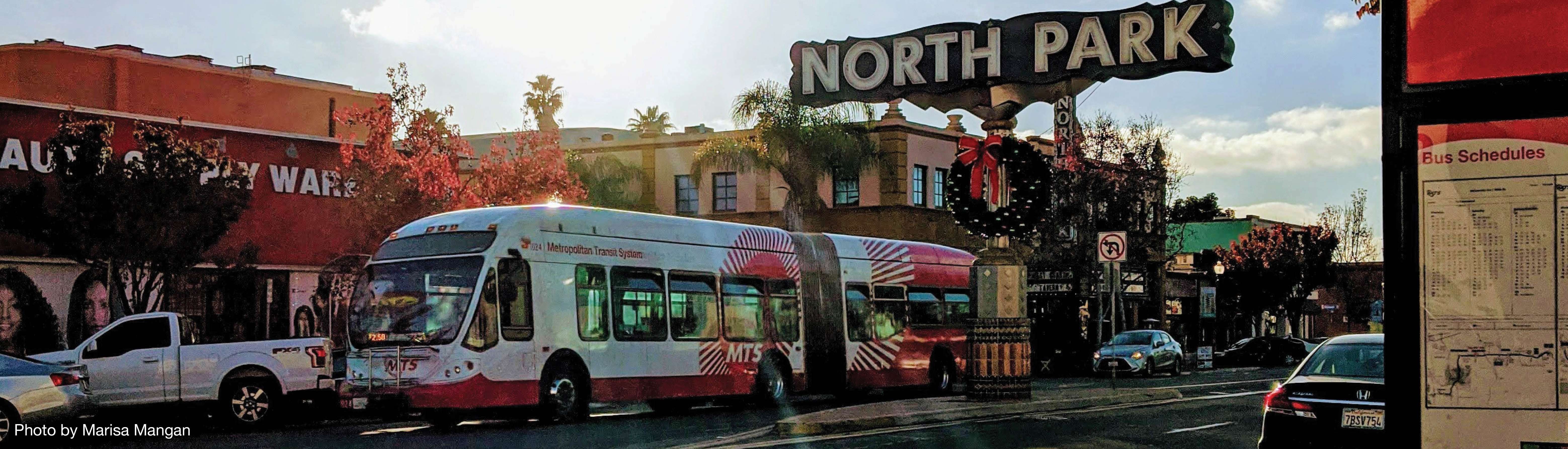
Thanks in part to Proposition 1B bond money, MTS has ordered 26 new buses manufactured by North America Bus Industries. They are due to begin arriving in San Diego by early fall of this year. California Governor Arnold Schwarzenegger held a news conference with MTS on Tuesday, June 10, to announce that $27 million in Proposition 1B money had been provided to MTS to purchase the NABI buses. MTS will also purchase new 40-foot New Flyer buses with the money, putting MTS on track to retire all of its diesel buses over the next three years.
Anniston, AL (May 13, 2008) – With a fleet of articulated vehicles already extended past its retirement point, the San Diego Metropolitan Transit System came to North American Bus Industries Inc. to help them fill their need for replacement vehicles. The result is an order of 26 NABI 60-foot BRTs with CNG powerplants.
“These buses are going to add an exciting new dimension to our transit service here in San Diego,” said Paul Jablonski, Chief Executive Officer of MTS. “We currently don’t have anything like these vehicles in our fleet. When people see them and ride on them, they are definitely going to create a ‘wow’ factor and enhance the MTS image.”
Bill Coryell, VP of Sales, Western Region, North American Bus Industries, Inc. said the San Diego MTS’ close liaison with the Los Angeles MTA had a significant influence on the decision. Although six different operators have now purchased similar vehicles, the MTA alone operates nearly 400 of the big NABI BRTs.
The option of getting the BRT with a CNG propulsion also influenced the decision. “In California, the Air Resources Board requires transit agencies to pick a ‘fuel path’ that they can get on and stay on.” Jablonski said. “We chose CNG as our fuel path, and have been slowly converting our fleet over from diesel engines. NABI’s BRTs were the only articulated vehicles that met our requirements and offered a CNG option. So it’s a great fit for us.”
“By concealing the 10 CNG fuel tanks and the air conditioning units inside the BRT’s ceiling, we’ve really kept this vehicle streamlined,” Coryell added. With those 10 tanks, the BRT has a 400-mile range. Other features included on the San Diego package are air disc brakes on all wheels for superior performance and easier maintenance. The buses also feature three doors to help speed boarding and reduce dwell times at stops. The buses are powered by 320 HP Cummins powerplants coupled to Allison automatic transmissions with lock-up torque converter and hydraulic retarder. All 26 buses are planned for delivery in late September 2008.
About Us: North American Bus Industries, Inc. markets three successful transit bus brands: NABI, Optima and Blue Bird offering a complete line of standard and low-floor, heavy-duty 30’, 35', 40', 42’, 60’ and 65' (articulated) transit buses at its facilities in Anniston, Alabama. North American Bus Industries is the market leader with its sleek and most advanced designed BRT (Bus Rapid Transit) vehicles which offer a cost effective alternative to expensive light rail. The transit buses are available with clean diesel, CNG, LNG, or diesel hybrid-electric propulsion systems.

Time: 10:15 a.m.
Date: Tuesday, June 10, 2008
Event: Press Conference, Fashion Valley Transit Center, Fashion Valley Road and Riverwalk Drive, San Diego, CA
HARRY MATHIS:
Well, good morning, ladies and gentlemen. I'm Harry Mathis, chairman of the board of the Metropolitan Transit System. Joining me are MTS CEO Paul Jablonski over here and Claire Spielberg, who is our chief operating officer of our Bus Transit System.
You know, we're very pleased and honored to welcome our Governor here today, especially with the good news that he brings us. Proposition 1B, thanks to the wisdom and vision of the Governor and the support of the voters, has proven to be extremely important to MTS and to the people we serve, who depend on us for their transportation needs to the tune of 90 million trips a year -- that's 90 million trips a year on our system. And it's growing -- growing, as you can imagine, with the increased cost of fuel, 6 percent on the bus side, 8 percent on the rail side. So we have a service that people are depending on and it becomes more important with each passing day.
Well, thanks to the voters of California who supported the Governor's package, 1B, were very pleased to be here on this occasion and talk about the benefits that we've received in terms of being able to buy new equipment. With the money that we're receiving in this first installment of Proposition 1B we're able to retire buses that operate on diesel -- that are well beyond their useful life, have become very expensive to maintain -- with newer buses, more comfortable buses, buses that are better state-of-the-art, that burn compressed natural gas for the benefit of the environment. So, it's really a pleasure for us to be able to do that, so, it's truly a great day for San Diego.
As I bring the Governor up here to the podium I'd like to make a little presentation. Governor, if you could join me here a second? I'd like to give you a little token of our appreciation. These are tokens that used to be used on the system by one of our predecessor agencies. You know, we've been providing public transportation, us and our predecessor agencies, for more than 122 years. And so these tokens, as I recall, they used to go for five cents and you could ride the system then. But we had them made into these cufflinks for you and we'd like you to have those as a token of our appreciation.
GOVERNOR SCHWARZENEGGER:
Well, thank you very much. Thank you.
HARRY MATHIS:
So it's my pleasure then to turn the podium over to you, Governor.
GOVERNOR SCHWARZENEGGER:
Thank you. Well, thank you very much, Harry, for the nice introduction. And it is wonderful to be back again in San Diego, I always love coming back here. And I want to thank everyone that is here today, from Harry Mathis, the chair of the San Diego Metropolitan Transit System, to Danny Curtin, who is with the California Conference of Carpenters and Jim Earp, California Alliance for Jobs, and Jim Madaffer from the San Diego Association of Governments. And all the others that are here today, we want to thank you very much.
I have talked about transportation infrastructure and about rebuilding California now since I have come into office. As you know, I've been pushing that because I have always been a strong believer that we have to rebuild California, that for the last four decades we really haven't done anything but our population has grown. So we are very happy that in 2006 the people of California have approved $42 billion of infrastructure bonds. And part of that money goes to transportation and public transportation projects, protect our environment, improve public safety, reduce traffic congestion and create jobs all at the same time. And we all know that the faster we move people and goods around in the state of California, that is true economic power.
So today, I'm very proud to announce that we have allocated another $136 million in Proposition 1B money for transportation projects up and down the state of California. This money will also be leveraged to $270 million from other local, state and federal funds and sources, and provide an even bigger boost to our economy. We will see new jobs because of that, new buses, new vehicles for the disabled and upgraded transit stations. Right here in San Diego they will use more than $9 million to replace older buses for fuel-efficient models and bringing the San Diego region's total money from transit bonds to nearly $36 million this year alone.
(Applause)
With gas prices approaching $5 a gallon, providing transportation and fuel options is more important than ever. That is why I have devoted more than $5 billion to public transportation in my budget since I have taken office. And we won passage of Proposition 1A in 2006, which ensures that 20 percent of our revenues from our sales tax on gasoline goes to public transportation projects.
But our work to end traffic gridlock and fight global warming does not end here. First of all, California is leading the nation in encouraging and developing alternative fuel choices with our Low Carbon Fuel Standards. And we are also committed to rebuilding California's entire transportation infrastructure like never before and working to allocate bullions of dollars from Proposition 1B as quickly as possible.
And to help even further, I have formed the Build America's Future with Governor Rendell and with Mayor Bloomberg to put the pressure on Washington to rebuild not only California but the whole United States, all the infrastructure, because it's aging and it needs upgrading. We are very fortunate that we have had many meetings on this subject and also press conferences to put the spotlight on this very important issue, and several other governors have now joined us.
Because of our broken budget system and because of our $17.2 billion deficit we cannot afford to increase subsidies for local transit operations in the upcoming budget, but that doesn't mean that we are decreasing it, either; we are just keeping it flat. I'm very frustrated about our budget system and I think this is why it is very important that we do everything we can to fix our dysfunctional budget system this year, because it's irresponsible to send transportation, education, health care, law enforcement, prisons and all those different areas on a rollercoaster ride where everyone has to hold on for dear life. So we urge everyone in California to send a message to the legislature to fix the budget system once and for all, so that we have a steady growth and steady funding sources for transportation and for all the other areas.
Thank you very much. And now the next speaker who will come up is Jim Earp, who is going to talk a little bit more about transportation. Thank you very much. And I also want to thank Will Kempton for being here today. Thank you very much.
(Applause)
JIM EARP:
Thank you, Governor. A year and a half ago, as chair of the Prop 1A-1E committee, I had the opportunity to travel up and down the state with the Governor to explain, to help him explain to the voters, why this was so important. It was a vision that he's had, as he said, from the very beginning of his governorship. He worked diligently to do that. I can't tell you how many press conferences were held.
But here's the part I really like. The voters got that, and they voted for it and supported it. But now a year, year and a half down the road, that money is starting to come through the pipeline and he's spending as much, if not more energy, reminding the voters of how this money is going to work for them, than he did trying to get them to vote for it. And it's not just in press conferences like this. You can go to the website and all the bond money, all the projects it's supposed to fund, are laid out there and the information is there, to tell you how the progress of those projects are going, so I think that's a very telling remark about what this Governor thinks about infrastructure investment in this state.
Today we're talking about putting some private money -- or excuse me, public transit money -- from the bonds to work. It's very timely, particularly in this time with high gas prices. The voters are getting a choice for other modes of transportation other than taking their cars. It's very important, because the bonds, a lot of the money is going into infrastructure development, whether it's freeway widening and a lot of other projects throughout the state to improve safety and reduce congestion. But this is important here because these buses, without that project investment, would not be able to work as effectively. So you see a whole system happening here and that's very critical for the success of these bonds.
Finally I'd just like to point out that we all recognize that even with $20 billion going into the transportation system, made possible by Proposition 1B, even with the additional 1.5 billion that goes into transportation made possible by Proposition 1A, we all recognize it's not enough. And the Governor has worked diligently for performance-based investment in infrastructure -- we also call it public-private partnerships. We all realize the importance of partnering with the private sector to enlarge that pie, get more money into the transportation system so that we can get this state moving again. And we need help with that. It's not happening in the legislature and it needs to happen in the legislature. And we are working diligently with the Governor and with the legislature to try to get them off high-center for this, because without it we're not going to get to where we need to be.
Governor, once again I thank you for your leadership. And before I end -- this is the part I always mess up, I always forget to introduce the next speaker. But today I’m not. The next speaker is Danny Curtin, who is the director of the California Conference of Carpenters, and he will also speak a little bit about transportation.
(Applause)
DANNY CURTIN:
Thank you very much. Jim always messes that up. I've only known him for 30 years, so it's a tough one to mess up in this case. Okay, the Governor is one of my biggest fans. He may be my only fan, I think. You can check that out, too, in Sacramento.
I represent the Carpenters Union and I am very, very pleased to be here. I would say in normal times I would be extremely pleased to be here. When you talk about $37 billion in bonds -- $42 billion in bonds when you add some of the water issues -- we're talking about transportation, we're talking about transit, we're talking about $10 billion for schools, we're talking about rebuilding California's levees -- which, while it may not seem important right here in San Diego, if they collapse you've got no water, so it is very, very important.
In normal times this would be a wonderful place to be to announce the expenditure of these monies, because these kind of things put carpenters and other people who work in the construction industry directly to work, so that would be something we would be pleased about on the natural. But these are not normal times; these are very, very difficult times. The economy is in some ways in bad trouble, in some ways sort of humming along. It's really kind of complicated and you're seeing more and more of it.
But you couldn't ask for a better investment at a better time than $42 billion of infrastructure investment into the economy. It used to be called “counter-cyclical investment”. It's a very hard thing for government to do. It just turned out -- and I know the Governor had this in mind when he was pushing these bonds, in case there's a downturn the state is going to invest in the economy and keep the California economy humming along as well as possible, keep people working, good jobs, incomes coming in. That's what infrastructure does. For us immediately, the bonds equal jobs. But infrastructure equals a growing economy. You do not have a growing economy without infrastructure and it's desperately needed, because as I said, these are not normal times.
The Governor did refer to the global warming issue and it's another thing I want to congratulate him and the legislature on. California is the world leader on the global warming issue. When people talk about it internationally, they speak of California. And you couldn't ask for a better investment for global warming issues than the one you're seeing right here. You'll hear more about the transit, or you've heard about the buses being changed over from older buses to more efficient buses. All the new buses are condensed-natural-gas buses. They will reduce the global warming dramatically.
On top of that -- and I would say if there was anything that will ever get the attention of California citizens and the American people, it's $4.50 for a gallon of gas -- if there's ever a time people are going to get on these buses it's going to be now. There's going to be more use of transit, more trains. And I tell you again, the Governor is a big proponent of high-speed rail, which we're trying to push and working with the Governor on. We need to change the way we're doing business and $4.50 a gallon -- going to $5, I'm quite sure -- will get the American people and the California people's attention and it will change the way we do business. It will be putting more people on these buses and it will be good in many ways.
But in terms of changing the way we do this infrastructure, the Governor is leading the way on the national level. We have to rebuild our infrastructure. It's not going to be the same infrastructure. Its going to one that's sensitive to the global warming issue, getting the carbon out of the atmosphere and the other greenhouse gases. So there will be jobs, it will help grow the economy and it will bring a better environment to all of us. And right here in San Diego you're completely familiar with that. That's one of the great reasons to live here.
So I really do want to thank the Governor for not leading just the infrastructure conversation, but the global warming conversation, the high-speed rail, the health care.
And I cannot leave this podium without talking about the water conversation. Of all places in the state of California, you're at the end of the spigot here. There's a diesel plant being talked about, but the Governor has put a full water plant on the table. It's this kind of vision and this kind of leadership that we really need. I'm proud to be with the Governor on this. We're happy to see in California we've got two more years to talk about this. Let's keep moving on it at the same time, hopefully, we get some of these things done.
So I have the pleasure now of introducing the next speaker, which is City Councilman Jim Madaffer, who I'm proud to say is also the president of the League of Cities -- so that gives San Diego a little bit more say in what's happening around the state and in Sacramento -- and also the chairman of the Transportation Committee of SANDAG. This is a very busy guy. I just get sort of tired just saying what he does. So with that, I'm going to bring him up here and have it. Thank you.
(Applause)
JIM MADAFFER:
Thank you very much, Danny. And Governor, as always, it's always good to have you here in San Diego. And on behalf of the city of San Diego and the San Diego region, thank you very much for your efforts in putting forward the Proposition 1B dollars. They both are working, not only in our region here, but throughout California as well.
You know, I'm in a unique perspective, as Danny said, not only chairing the SANDAG transportation committee where we work on these issues day in and day out, but also in my role traveling all over California as president of the League of California Cities. One of the things that I've had the opportunity to talk to the Governor about has been the incredible lack of infrastructure -- the deficit, actually, that we have for infrastructure in this state -- probably close to half of $.5 trillion, $500 billion.
You know, Prop 1B is a great start, but clearly the people of California, certainly of San Diego, need to realize that the investments we're making today are just but a beginning, a down payment on really what we're going to have to do in our state into the years ahead. But this down payment has been phenomenal, and without this Governor recognizing the importance of infrastructure and restoring and rebuilding our infrastructure in this state, I'm not sure where we would be.
San Diego has benefitted from two Prop 1B programs, more than $450 million in what's called the “Congestion Mitigation and Improvement Account”, or CMIA. And then, most recently, San Diego received another $400 million from the Trade Corridors Improvement Fund for six different projects, ranging from the border to goods movement projects along our ports.
These funds are being put to work to improve our regional transportation systems for such things as our new managed lanes on Interstate 15, provide congestion relief on Interstate 5 and 805 where they merge into Sorrento Valley, and along the 805 in the south bay. And these bond dollars are allowing us to compete several multimodal projects that will improve goods movement in our border region, including 905, the new port of entry we're going to be building at SR-11 -- this will be a third border crossing along the border -- the San Ysidro intermodal yard as well as access improvements from marine terminals and coastal rail.
Along with these highway, freight, rail and port access improvements, Prop 1B funding is going right here, as we are, for public transit. It's part of the mix to help keep San Diego moving. We really appreciate the $600 million that Prop 1B is providing transit in this year's budget, known as the Public Transit Modernization Improvement and Service Enhancement Account. These funds have enabled our transit partners to purchase these new replacement buses and to help complete a critical rail transit project between Escondido and Oceanside, more commonly know as The Sprinter.
We also want to thank you, Governor, for the $350 million in PTMISEA Funds proposed in the 08-09 -- you try saying that fast -- that's proposed in the 08-09 budget. And we certainly appreciate your constant efforts in getting these dollars out as quickly as possible. Clearly the legislature knows it; we've just got to keep reminding our friends in the legislature that we need to get these transportation dollars into the field so they can make improvements right here.
So together with these state, interstate and public transit improvements, they make up the core of our regional transportation system and they enable us to move commuters more efficiently, including goods, throughout San Diego and the state of California. So Governor, on behalf of SANDAG, on behalf of the city of San Diego and our entire region, we again thank you so much for your leadership in infrastructure and in transportation throughout the state. Thank you so much.
(Applause)
GOVERNOR SCHWARZENEGGER:
Thank you very much. And I just want to have Will Kempton come up here just for a minute. And the reason is because I think it's very important. When we put $20 billion aside for transportation infrastructure, that's one thing, and that's a miracle that this happened, because like I said, in 40 years this didn't happen. But then to divide it up and to work with all of the cities in California so that it trickles down, so that every city has benefits from that and that the mass transportation system has benefits and that we know exactly where we are going to have onramps and offramps built and where we're going to widen the roads and add another lane or another HOV lane and all of those things -- it's a complicated way of going about it. And everyone is screaming and wants to have money.
So I just want to have, quickly, I want to thank Will Kempton, who has mastered it, to divide it up in such a graceful way. But I just want to have you just talk a little bit about that, the important of that. (Applause)
DIRECTOR WILL KEMPTON:
Thank you, Governor. Well, it is absolutely the Governor's leadership that has focused attention on performance, accountability, and transparency. He wants to make sure these dollars get out very, very quickly. He wants to make sure that we're accountable to the voters and that people can know what's happening and can follow the progress of this work.
We are making great progress. Under the Governor's leadership we have already put $8 billion of the Transportation Bond out the door. That means it's allocated to projects, it's being spent on transportation improvements in California. We have also, or will by the end of August, complete the programming for about 11.5 billion of the total amount. Some of these dollars the California Transportation Commission or Caltrans do not control, such as the Port Mitigation money that's under the auspices of the Air Resources Board, and the Port Security money that's handled through the Office of Homeland Security.
But the dollars that we have for transportation, as Jim Earp and others have indicated, this is key to California's economy. For every billion dollars we can put out there in capital improvements, we are creating 18,000 jobs, and that's a conservative number. And so I really applaud the Governor's leadership. It's been a pleasure to work for him and it's been really an honor to produce this amount of infrastructure improvements for the state of California.
(Applause)
GOVERNOR SCHWARZENEGGER:
Thank you very much, Will. Thank you. I just want to say it's always nice to see what effect leadership has, because Caltrans was for many years in a big mess. And then, all of sudden now, they're doing an extraordinary job and I'm very proud of Caltrans because of the leadership of Will Kempton, so thank you very much.
So if you have any questions about any of this, please feel free to ask.
QUESTION: Governor --
GOVERNOR: Yes. We have a mic.
QUESTION: The budget is supposed to be enacted in five days and the Assembly and Senate Democrats have yet to introduce a plan that comes close to balancing it. They call for $6 billion in unspecified revenue increases. Is it responsible to propose a budget and not talk about what taxes you actually want to hike?
GOVERNOR: Well, let's be positive here for a second. I have to say that I'm happy that they are working on the budget. You see how little I'm happy with, when you work in Sacramento? Because we have proposed our budget on January 10th and since then there's six months, and they still haven't really figured out what they want to do.
But I'm happy that the Assembly and the Senate has now finished their meetings, their committee meetings, and now they're going to have their conference committee meetings where the Senate and the Assembly get together and have those discussions about the budget. And I'm looking forward to working with them.
I think it is very important that, besides solving the budget problem of 2008-2009, that we also solve and fix our dysfunctional budget system. That is the most important thing. And there will be, you know, all kinds of negotiating going on and I made it very clear everything is on the table. I want to make sure that everyone feels that their creativity and their thoughts and everything ought to be part of the discussion. We have good leaders, I think we have smart people up there, so it just depends on the willingness.
Do they look back at the last few decades and say we have had a horrible budget system that has gotten us into deep trouble many times where we had to raise taxes, where we almost were bankrupt, the state of California, where we didn't know how to make our next payments, that created the recall election and all of those kinds of things? Shouldn't we straighten out that mess once and for all?
And I say yes, it's the time to straighten out the mess once and for all, so that we have a continuous increase in funding on all of the programs. Because we have an increase, average increase, of five percent of revenues every year over the last 10 years, so therefore there is no reason to all of a sudden fund less one year and more the next year, or to suspend Proposition 98, or anything. I think that we can have a continuous increase in funding.
But we have to fix the budget system so that we don't spend all the money when we have a surge in revenues and then, therefore, we don't have enough money when we have a downturn like right now. Right now we have no money, and therefore we have to make adjustments, cost-saving adjustments, to be fiscally responsible.
And I also want to add that the polls, the latest polls show very clearly that the people know about our $17 billion deficit, and it is 2-to-1 that are in favor of cuts and cost-saving adjustments versus raising taxes. We can't go to the people every time when Sacramento screws up and ask the people of California for more tax money, increase the taxes and punish the people for something that's not their fault.
QUESTION: Do you still feel that your 2006 approach, post-partisan, cooperative, is more likely to be get reforms done that your direct approach of 2005 in the special initiatives, special election?
GOVERNOR: I think that we, Democrats and Republicans, want to have this resolved, they want to have a coherent budget system. And so it's just a matter of everyone has a different approach to get together. It has nothing to do much with the party itself, or with the parties. It has to do with just the will of everyone coming together and saying let's fix this. I think the people of California deserve a good budget system and they deserve a steady increase in funding of all of the programs.
QUESTION: Isn't that more likely to happen with initiatives than with the legislature, which you call dysfunctional?
GOVERNOR: Well, you know, like I said, I don’t want to say that. I just would say that it just takes always an extra push for the legislature. And then this year, it's election year, so I really don't know how that plays into the whole dynamic of the whole thing. But like I said, I have faith in them and I'm looking forward to working with them and solving that. It's the very same legislature that has voted for the infrastructure bonds, let's not forget. That is extraordinary, that's a historic accomplishment. And so I think that same legislature can also go and vote for a water infrastructure bond. That same legislature can also vote for a health care, reforming the health care system and creating a good coherent health care system where people all are insured. They can do it, I'm absolutely convinced. Again, it's just a matter of the will and to push them so they do that.
|